
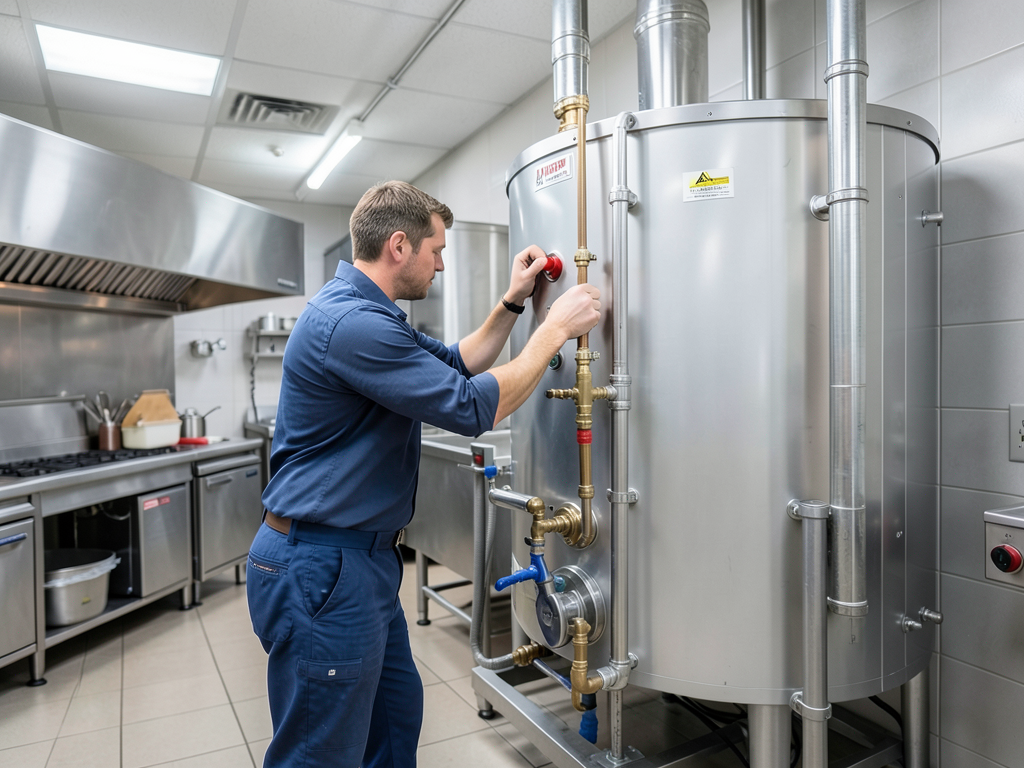
How to tell if your West Milwaukee business needs a larger commercial water heater
Your commercial water heater is the unsung hero of your business operations. When it works properly, nobody notices. But when it fails to keep up with demand, the entire workflow grinds to a halt. For West Milwaukee businesses experiencing hot water shortages during peak hours, the question isn’t whether you need a larger unit – it’s how much larger you need to go. The best options for water heater replacement in Wauwatosa.
The answer depends on several factors specific to your business type, building layout, and Milwaukee’s unique climate conditions. This guide walks you through the diagnostic process to determine if your current water heater is undersized and what sizing calculations matter most for local businesses. Reliable Milwaukee sump pump repair services to keep your basement dry.
Understanding commercial water heater sizing fundamentals
Commercial water heaters differ significantly from residential units in both capacity and recovery rate. While a home might use 40-50 gallons stored at a time, commercial applications require continuous availability measured in gallons per hour (GPH) recovery. The key metric is whether your unit can replenish hot water fast enough to meet peak demand periods.. Read more about Why your tankless water heater needs a descale every year in Brookfield.
For West Milwaukee businesses, this calculation must account for Milwaukee’s average groundwater temperature of 40-45°F during winter months. This means your water heater must raise incoming water temperature by 65-70°F to reach the standard 110°F delivery temperature – a significant energy requirement that impacts both sizing and operating costs.. Read more about Why your Muskego water heater is dying early (And how an anode rod saves it).
7 critical signs your business needs a larger commercial water heater
Before diving into calculations, recognize these operational red flags that indicate your current system is struggling:
- Consistent hot water shortages during peak business hours – If your restaurant runs out of hot water during the dinner rush or your hotel experiences complaints during morning checkout, your recovery rate is insufficient.
- Recovery time exceeds 1 hour for a 70% drawdown – Time how long it takes to recover after heavy usage. Commercial units should recover 70% capacity within 60 minutes.
- Water temperature drops below 100°F during simultaneous usage – Multiple fixtures running at once should maintain minimum temperatures for health and safety compliance.
- Energy bills spiking without increased usage – An overworked unit running constantly to keep up indicates it’s operating inefficiently due to constant demand.
- Pressure fluctuations when multiple fixtures operate – Undersized units struggle to maintain consistent pressure during simultaneous demand.
- Visible corrosion or sediment buildup – Milwaukee’s hard water (18-22 grains per gallon) accelerates mineral accumulation, reducing effective capacity over time.
- Frequent temperature limit switch tripping – The high-limit safety switch activates when the unit can’t maintain set temperatures under load.
Calculating your business’s peak hour demand
The foundation of proper commercial water heater sizing is determining your peak hour demand (PHD) – the maximum gallons of hot water used during your busiest hour. This calculation varies dramatically by business type:
Restaurant water heater sizing
Full-service restaurants typically require 10-15 gallons per seat during peak dinner hours. For a 50-seat restaurant, that’s 500-750 gallons of hot water needed between 6-8 PM. Factor in additional demand for dishwashing (2-4 GPM), hand washing (0.5 GPM per sink), and food preparation (2-3 GPM).
Milwaukee’s restaurant scene, particularly in the Historic Third Ward and Walker’s Point districts, often requires specialized venting and condensate removal due to the high BTU input needed for these recovery rates.. Read more about Making your Walker’s Point restaurant bathroom ADA compliant without a total gut job.
Hotel and hospitality sizing
Hotels calculate demand based on occupancy and amenities. A standard hotel room requires approximately 40-50 gallons per day, but morning peak demand (6-9 AM) can exceed 20 gallons per occupied room. For a 100-room hotel, that’s 2,000 gallons needed within a three-hour window.
Milwaukee’s hospitality businesses must also consider the impact of cold groundwater on recovery rates – a factor that can increase required BTU input by 15-20% compared to warmer climate calculations.
Healthcare facility requirements
Medical facilities require precise temperature control and higher recovery rates due to sanitation needs. Operating rooms need continuous hot water at 140-145°F, while patient areas require 110-120°F. The Wisconsin Department of Safety and Professional Services (DSPS) mandates specific temperature controls and mixing valve requirements for healthcare applications. Professional drain cleaning in Shorewood for stubborn kitchen clogs.
Milwaukee-specific water heater considerations
West Milwaukee businesses face unique challenges that affect water heater sizing decisions:
Groundwater temperature impact
Milwaukee’s proximity to Lake Michigan creates significant seasonal groundwater temperature variations. Winter temperatures can drop to 35-40°F, while summer temperatures may reach 50-55°F. This 15-20°F variation dramatically affects recovery calculations and energy consumption.
For accurate sizing, use the lowest expected groundwater temperature (typically January-February) rather than annual averages. This ensures your system can handle winter demands without strain.
Water hardness effects
Milwaukee’s water supply from Lake Michigan contains 18-22 grains per gallon of hardness minerals. This level of hardness causes scale buildup that reduces heating efficiency by 1-2% annually if not addressed. Commercial units in West Milwaukee typically require water softening systems or regular descaling maintenance to maintain rated capacity.
Building age and infrastructure
West Milwaukee’s industrial heritage means many commercial buildings were constructed between 1920-1970. These structures often have existing plumbing that may not support modern high-recovery units without upgrades. Galvanized steel pipes common in older buildings restrict flow rates and may require replacement to achieve rated performance. What to do if your pipes freeze during a Milwaukee cold snap.
Commercial water heater sizing calculation method
Follow this systematic approach to determine your required water heater capacity:
Step 1: Calculate peak hour demand
Identify your busiest hour and list all hot water usage during that period. For restaurants, this might be dinner rush (5-8 PM). For hotels, morning checkout (6-9 AM). Sum the gallons used by each fixture:
- Dishwashing: 2-4 GPM x minutes of operation
- Hand washing: 0.5 GPM x number of sinks x usage time
- Food prep sinks: 2-3 GPM x usage time
- Restroom fixtures: 2.2 GPM x number of flushes
- Specialty equipment: Check manufacturer specifications
Step 2: Determine required recovery rate
Recovery rate is calculated as: Peak Hour Demand ÷ Recovery Time. Standard commercial units recover 70% of capacity in 60 minutes. If your PHD is 500 gallons, you need a unit that can recover at least 357 gallons per hour (500 × 0.70).
Step 3: Calculate BTU input requirements
BTU requirements depend on temperature rise and recovery rate. The formula: BTU/hr = GPH × Temperature Rise × 8.33. For Milwaukee’s 40°F groundwater and 110°F delivery temperature, the temperature rise is 70°F.
Example: 357 GPH × 70°F × 8.33 = 208,000 BTU/hr input required.
Step 4: Select appropriate unit type
Based on your calculations, choose between:
- Storage tank units: Best for consistent demand patterns with defined peak periods
- Tankless units: Ideal for variable demand or limited space
- Hybrid systems: Combine storage and tankless for maximum flexibility
Storage vs. Tankless: Which is right for your West Milwaukee business?
| Factor | Storage Tank | Tankless |
|---|---|---|
| Initial Cost | $2,000 – $5,000 | $3,000 – $7,000 |
| Operating Efficiency | 60-70% | 80-95% |
| Space Requirements | 5-10 sq ft floor space | Wall-mounted, minimal floor space |
| Recovery Rate | 70% capacity in 60 minutes | Unlimited (flow-dependent) |
| Best For | Restaurants, hotels, healthcare | Small offices, salons, variable demand |
| Milwaukee Climate Impact | Higher standby losses in winter | Must be sized for 40°F inlet temperature |
When storage tanks make sense
Storage tanks work best for businesses with predictable peak periods and high simultaneous demand. Restaurants benefit from storage capacity because they can heat water during off-peak hours when energy rates are lower. The 70% recovery rate within one hour aligns well with typical dinner service patterns.
Tankless advantages for variable demand
Tankless units eliminate standby losses and provide unlimited hot water for businesses with variable demand patterns. Salons, small offices, and businesses with irregular hot water usage benefit from the efficiency and space savings. However, they must be properly sized for Milwaukee’s cold inlet temperatures to avoid flow restrictions.
Wisconsin code compliance and installation requirements
Commercial water heater installations in West Milwaukee must comply with Wisconsin Plumbing Code SPS 382 and local Milwaukee ordinances. Key requirements include:
Temperature control and mixing valves
Wisconsin DSPS requires thermostatic mixing valves on all commercial water heaters serving multiple fixtures. These valves maintain consistent outlet temperatures and prevent scalding. For healthcare facilities, ASSE 1070 certified valves are mandatory for hand washing fixtures.
Venting requirements
High-efficiency units (90%+ AFUE) require specific venting materials. PVC venting is prohibited for units over 50,000 BTU/hr input. Category III stainless steel venting or power venting systems are required for most commercial applications in West Milwaukee’s older buildings.
Expansion tank sizing
Closed-loop systems require thermal expansion tanks sized for the system volume. A commercial unit serving 10+ fixtures typically needs a 2-5 gallon expansion tank with a pre-charge pressure matching the incoming water pressure.
Backflow prevention
Milwaukee Water Works requires reduced pressure zone (RPZ) backflow preventers on all commercial water heater installations. These devices protect the municipal water supply from contamination and must be tested annually by certified testers.
Professional sizing assessment: When to call the experts
While these calculations provide a starting point, several factors require professional assessment:
Complex demand patterns
Businesses with multiple peak periods or highly variable demand need detailed usage analysis. Restaurants with banquet facilities, hotels with conference centers, and healthcare facilities with surgical suites require specialized load calculations that account for simultaneous usage patterns.
Existing infrastructure limitations
Older West Milwaukee buildings may have gas lines, electrical service, or venting that cannot support larger units without upgrades. A professional assessment identifies these constraints before purchase.
Energy efficiency considerations
High-efficiency units cost more upfront but can reduce operating costs by 20-30%. The payback period depends on your usage patterns and local utility rates. Professional analysis calculates lifetime costs including installation, operation, and maintenance.
Code compliance verification
Commercial installations must comply with current codes, which change periodically. Professional plumbers understand the latest requirements for venting, combustion air, relief valve discharge, and seismic bracing in your specific building type.
Cost factors beyond the unit price
| Cost Component | Typical Range | Factors Affecting Cost |
|---|---|---|
| Unit Purchase | $2,000 – $10,000 | Capacity, efficiency rating, brand |
| Installation Labor | $1,500 – $4,000 | Building access, existing infrastructure |
| Code Compliance Upgrades | $500 – $3,000 | Venting, gas lines, electrical service |
| Permits and Inspections | $200 – $800 | Local municipality fees |
| Water Treatment | $800 – $2,500 | Hardness level, volume requirements |
| Total Project Cost | $4,500 – $20,000+ | Scope of work, building conditions |
Maintenance considerations for commercial units
Commercial water heaters require more frequent maintenance than residential units due to higher usage and harder water conditions in West Milwaukee:
Annual maintenance schedule
Professional maintenance should include:
- Flushing to remove sediment buildup
- Checking and replacing anode rods
- Testing temperature and pressure relief valves
- Inspecting venting and combustion systems
- Verifying mixing valve operation
- Checking for gas leaks or electrical issues
Water treatment integration
Given Milwaukee’s water hardness, water softening systems are often integrated with commercial water heaters. These systems require regular salt replenishment and resin bed cleaning to maintain effectiveness and protect the water heater from scale buildup.
Emergency preparedness for water heater failure
Commercial water heater failure can halt business operations. Consider these emergency preparedness steps:
Redundancy planning
For critical operations, consider installing a secondary water heater or keeping a portable unit on standby. Restaurants might use portable tankless units for hand washing during main unit replacement.
Insurance coverage
Commercial insurance policies vary in water heater coverage. Review your policy to understand whether sudden failure is covered and what documentation is required for claims.
Emergency service relationships
Establish relationships with local plumbing contractors who offer 24/7 emergency service. Many West Milwaukee businesses keep priority service agreements with contractors for rapid response during failures. Rapid Response Leak Repair.
Frequently Asked Questions
How do I know if my current water heater is properly sized?
Monitor hot water availability during your busiest hour. If you consistently run out of hot water or experience temperature drops, your unit is likely undersized. A properly sized unit should maintain temperature during peak usage with 30% capacity remaining.
What size water heater do I need for a 100-seat restaurant?
A 100-seat full-service restaurant typically needs a 100-120 gallon storage tank with 199,000-250,000 BTU input, or equivalent tankless capacity. This assumes dinner rush demand of 1,000-1,200 gallons over three hours.
How does Milwaukee’s cold groundwater affect sizing?
Cold groundwater increases required BTU input by 15-20% compared to warmer climate calculations. A unit sized using standard formulas may struggle during West Milwaukee winters. Always use the lowest expected groundwater temperature for accurate sizing.
Are tankless water heaters worth the higher upfront cost?
Tankless units save 20-30% on operating costs and last 5-10 years longer than storage tanks. For businesses with high usage, the lifetime cost is often lower despite higher initial investment. Calculate payback based on your specific usage patterns.
What permits are required for commercial water heater replacement?
Milwaukee requires plumbing permits for commercial water heater replacement. The permit process includes plan review for compliance with Wisconsin Plumbing Code SPS 382, and final inspection to verify proper installation and safety devices.
How often should commercial water heaters be replaced?
Commercial units typically last 8-12 years with proper maintenance. Signs replacement is needed include frequent repairs, rising energy costs, inconsistent temperatures, and visible corrosion. Annual professional inspections help determine optimal replacement timing.
Ready to solve your hot water problems?
Don’t let inadequate hot water capacity hurt your business operations. The team at Elite Plumbing Milwaukee has been sizing and installing commercial water heaters throughout West Milwaukee for over 15 years. We understand the unique challenges of Milwaukee’s climate, water conditions, and building infrastructure.
Our professional assessment includes detailed load calculations, existing infrastructure evaluation, and code compliance verification. We’ll recommend the right size and type of unit for your specific business needs, not just sell you the most expensive option.
Call (414) 375-7955 today to schedule your commercial water heater assessment. We’ll help you avoid the costly downtime and customer complaints that come with undersized systems.
Additional Resources
For more information on commercial plumbing systems and local regulations, visit:
- Wisconsin Department of Safety and Professional Services Plumbing Program
- Milwaukee Water Works
- American Society of Plumbing Engineers
{
“@context”: “https://schema.org”,
“@type”: “BlogPosting”,
“headline”: “How to tell if your West Milwaukee business needs a larger commercial water heater”,
“description”: “Is your West Milwaukee business running out of hot water? Learn the signs your commercial water heater is undersized and how to calculate peak demand for your facility.”,
“wordCount”: 2347,
“datePublished”: “2026-05-20T12:47:00.000Z”,
“dateModified”: “2026-05-20T12:47:00.000Z”,
“inLanguage”: “en-US”,
“mainEntityOfPage”: {
“@type”: “WebPage”,
“@id”: “https://eliteplumbingmilwaukee.com”
},
“publisher”: {
“@type”: “LocalBusiness”,
“name”: “Elite Plumbing Milwaukee”,
“url”: “https://eliteplumbingmilwaukee.com”
},
“author”: {
“@type”: “Organization”,
“name”: “Elite Plumbing Milwaukee”,
“url”: “https://eliteplumbingmilwaukee.com”
},
“image”: {
“@type”: “ImageObject”,
“url”: “https://eliteplumbingmilwaukee.com/wp-content/uploads/2026/03/how-to-tell-if-your-west-milwaukee-business-needs-1.png”
}
}
{
“@context”: “https://schema.org”,
“@type”: “Plumber”,
“name”: “Elite Plumbing Milwaukee”,
“url”: “https://eliteplumbingmilwaukee.com”,
“address”: {
“@type”: “PostalAddress”,
“addressLocality”: “Milwaukee”
},
“areaServed”: {
“@type”: “City”,
“name”: “Milwaukee”
}
}
{
“@context”: “https://schema.org”,
“@type”: “FAQPage”,
“mainEntity”: [
{
“@type”: “Question”,
“name”: “How do I know if my current water heater is properly sized?”,
“acceptedAnswer”: {
“@type”: “Answer”,
“text”: “Monitor hot water availability during your busiest hour. If you consistently run out of hot water or experience temperature drops, your unit is likely undersized. A properly sized unit should maintain temperature during peak usage with 30% capacity remaining.”
}
},
{
“@type”: “Question”,
“name”: “What size water heater do I need for a 100-seat restaurant?”,
“acceptedAnswer”: {
“@type”: “Answer”,
“text”: “A 100-seat full-service restaurant typically needs a 100-120 gallon storage tank with 199,000-250,000 BTU input, or equivalent tankless capacity. This assumes dinner rush demand of 1,000-1,200 gallons over three hours.”
}
},
{
“@type”: “Question”,
“name”: “How does Milwaukee’s cold groundwater affect sizing?”,
“acceptedAnswer”: {
“@type”: “Answer”,
“text”: “Cold groundwater increases required BTU input by 15-20% compared to warmer climate calculations. A unit sized using standard formulas may struggle during West Milwaukee winters. Always use the lowest expected groundwater temperature for accurate sizing.”
}
},
{
“@type”: “Question”,
“name”: “Are tankless water heaters worth the higher upfront cost?”,
“acceptedAnswer”: {
“@type”: “Answer”,
“text”: “Tankless units save 20-30% on operating costs and last 5-10 years longer than storage tanks. For businesses with high usage, the lifetime cost is often lower despite higher initial investment. Calculate payback based on your specific usage patterns.”
}
},
{
“@type”: “Question”,
“name”: “What permits are required for commercial water heater replacement?”,
“acceptedAnswer”: {
“@type”: “Answer”,
“text”: “Milwaukee requires plumbing permits for commercial water heater replacement. The permit process includes plan review for compliance with Wisconsin Plumbing Code SPS 382, and final inspection to verify proper installation and safety devices.”
}
},
{
“@type”: “Question”,
“name”: “How often should commercial water heaters be replaced?”,
“acceptedAnswer”: {
“@type”: “Answer”,
“text”: “Commercial units typically last 8-12 years with proper maintenance. Signs replacement is needed include frequent repairs, rising energy costs, inconsistent temperatures, and visible corrosion. Annual professional inspections help determine optimal replacement timing.”
}
},
{
“@type”: “Question”,
“name”: “Ready to solve your hot water problems?”,
“acceptedAnswer”: {
“@type”: “Answer”,
“text”: “Don’t let inadequate hot water capacity hurt your business operations. The team at Elite Plumbing Milwaukee has been sizing and installing commercial water heaters throughout West Milwaukee for over 15 years. We understand the unique challenges of Milwaukee’s climate, water conditions, and building infrastructure.”
}
}
]
}
{
“@context”: “https://schema.org”,
“@type”: “BreadcrumbList”,
“itemListElement”: [
{
“@type”: “ListItem”,
“position”: 1,
“name”: “Home”,
“item”: “https://eliteplumbingmilwaukee.com”
},
{
“@type”: “ListItem”,
“position”: 2,
“name”: “Blog”,
“item”: “https://eliteplumbingmilwaukee.com/blog”
},
{
“@type”: “ListItem”,
“position”: 3,
“name”: “How to tell if your West Milwaukee business needs a larger commercial water heater”
}
]
}
{
“@context”: “https://schema.org”,
“@type”: “Service”,
“serviceType”: “Plumbing”,
“provider”: {
“@type”: “LocalBusiness”,
“name”: “Elite Plumbing Milwaukee”,
“url”: “https://eliteplumbingmilwaukee.com”
},
“areaServed”: {
“@type”: “City”,
“name”: “Milwaukee”
},
“description”: “Is your West Milwaukee business running out of hot water? Learn the signs your commercial water heater is undersized and how to calculate peak demand for your facility.”
}